

You may feel like you have a big task ahead of you when it comes to renovating a floor, particularly if the surface is uneven or damaged.
Whether you’re preparing to lay tiles, laminate, vinyl, or flooring boards, a self levelling compound often makes the job much easier!
Ready to learn how to use self levelling compound? Continue reading.
How to Use Self Levelling Compound Over Tiles
Provided the tiles are firmly bonded and stable, it is possible to use self levelling compound over any existing tiles. However, cracked and loose tiles need to be repaired or replaced beforehand, otherwise the compound will fail to adhere properly.
Once you have secured the tile surface, we recommend using a primer to improve the bonding. Pour the levelling compound evenly and take care, especially around grout lines.
If deep grout lines are present, a good idea is to fill them slightly before pouring. That way, you will be able to achieve a uniform finish.
How to Use Self Levelling Compound on Concrete Floor
To complete this task successfully, the concrete should be clean. Make sure it is free of dust, grease, and loose particles. Any cracks or damaged areas should be repaired to prevent weaknesses.
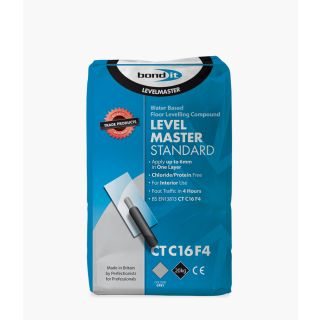
It’s important to use a high quality floor levelling compound. We recommend options like the Level Master Ad-Floor Levelling Compound.
Pour the compound evenly across the floor and use a gauge rake or trowel to guide it into low spots where necessary. The compound will naturally spread out and settle into a level surface. Once the compound has cured, the floor should be perfectly flat, providing an ideal foundation for tiles, laminate, vinyl, or other floor coverings.
In comparison to conventional screeds, going with a self levelling compounds enables faster and more accurate results.
How to Use Self Levelling Fibre Compound
Self levelling compound that is fibre reinforced contains minuscule fibres that improve factors like strength, flexibility, and crack resistance. They are massively helpful in areas where the floor may move slightly, or where there are temperature changes or underfloor heating.
The fibres work to hold the compound together while it cures and help prevent cracks to ensure that the finished surface remains stable over time.
In terms of the application process, it mirrors standard levelling compound. The primary benefit that comes with using fibre reinforced compounds is their ability to provide additional durability without compromising on a smooth and level finish.
Looking for Advice on Self Levelling Compound?
With self levelling compound, the two areas to get right are preparation and patience. Before getting started, clean and repair the floor (using a primer when needed) and work in manageable sections to avoid the mixture setting too quickly. Tools like spiked rollers and smoothing trowels can help you remove air bubbles and ultimately achieve a completely level surface.
If you have any further questions, please get in touch with the team. We will leverage our expertise to help you.